Know Your Investor (KYI)
The ultimate AML challenge
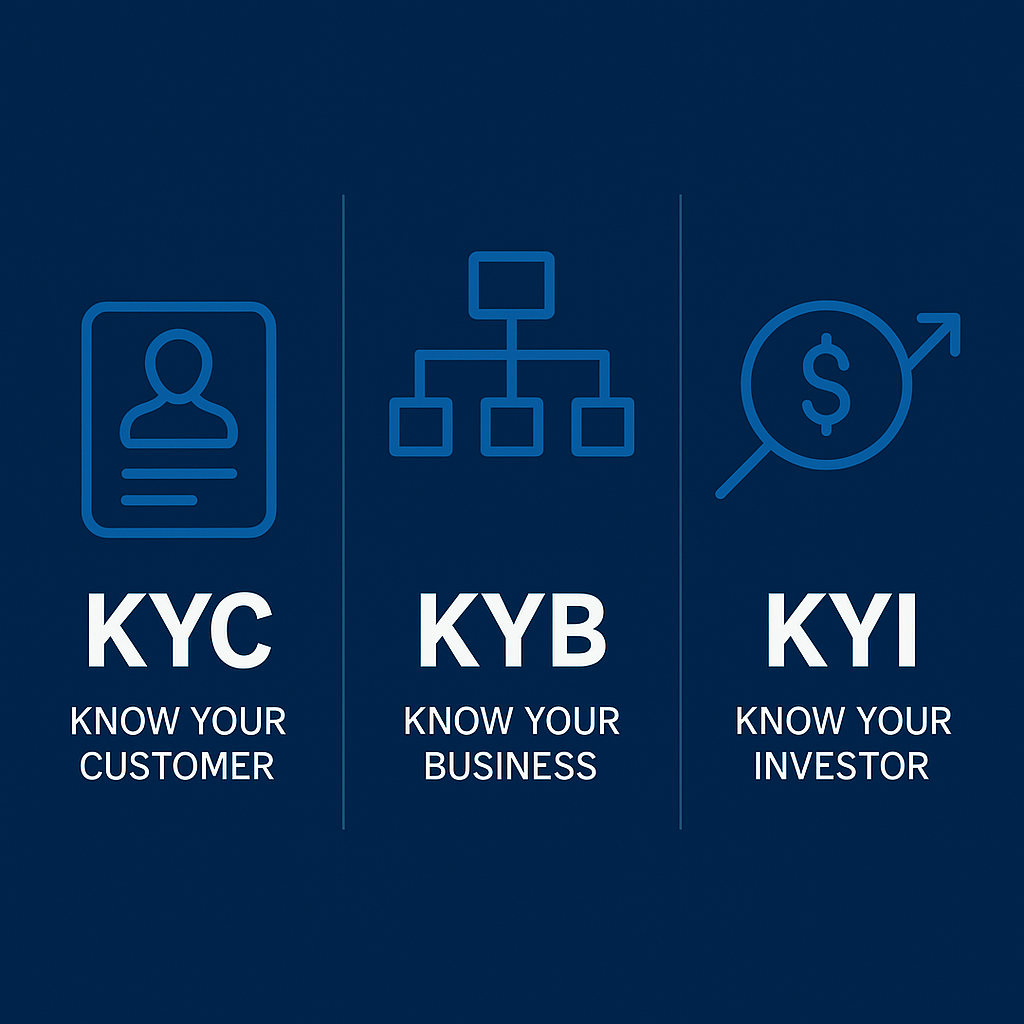

In financial services, acronyms like KYC (Know Your Customer) and KYB (Know Your Business) dominate the compliance conversation. But there’s a third, often more complex layer that many firms wrestle with behind the scenes: KYI - Know Your Investor.
Unlike retail banking or corporate account opening, investor onboarding carries its own set of challenges, combining elements of KYC and KYB with an added twist: investors are often institutional, global, and structured in ways that can stretch compliance frameworks to their limits.
What Makes KYI Different?
Multiple Layers of Ownership
KYC focuses on identifying and verifying individuals.
KYB assesses legal entities like corporations or partnerships.
KYI, however, means following the money back through a chain of structures: offshore funds, nominee accounts, feeder funds, trusts, and holding companies - to truly understand who the investor is and where the capital originates.
Regulatory Overlap, But No One Definition
Unlike KYC (with clear AML regulations) or KYB (with defined corporate registers), KYI obligations often sit in a grey zone. Regulators may not explicitly use the term “KYI,” but investment managers, private funds, and administrators are expected to create their own methodology to manage these complex structures.The Investment Context
Investors are not customers in the consumer sense. They are stakeholders, often committing millions into vehicles like funds, limited partnerships, or structured products. This changes both the expectation of due diligence and the scale of risk exposure.
How Firms Tackle KYI
Enhanced Due Diligence (EDD)
Going beyond passport scans and company extracts, KYI often requires mapping out ownership to the Ultimate Beneficial Owners (UBOs), validating source of wealth, and assessing the investor’s broader reputation (via PEP/sanctions screening, adverse media, etc.).
Structured Data Gathering
Subscription documents, investor questionnaires, and onboarding forms all form part of the data collection process. The challenge lies in standardising inputs across investors who may be individuals, corporates, family offices, or sovereign wealth funds.
Outsourced Serviced Providers
Many funds lean on administrators and transfer agents, who assume a significant role in investor due diligence. While this can relieve operational burden, it often creates friction due to differing standards of risks between the client and the outsourced service provider.
Technology & Automation
Unfortunately, there is a lack of RegTech solutions that can resolve the entire lifecycle of investor relations, and therefore firms will employ a number of fragmented tools including: case management systems, IDV apps, registry lookups, screening systems, investor portals, e-subscription systems. With the advent of AI, firms like Steward are able to enable a full AML stack to investment firms.
The Complications of KYI
Opacity in Structures
Some investors deliberately use layered jurisdictions (e.g., Cayman, BVI, Jersey, Luxembourg) that make tracing beneficial owners difficult. Without global registry harmonisation, KYI can become a detective exercise.Regulatory Fragmentation
U.S., EU, and offshore centres all approach investor due diligence differently. A fund manager marketing globally must navigate overlapping, but not identical, rules.High-Risk Profiles
Wealthy individuals, family offices, and politically exposed persons (PEPs) are disproportionately represented in investment structures. This heightens reputational and financial crime risk.Operational Bottlenecks
Investor onboarding can take weeks or months if KYI is handled manually - jeopardising capital calls, fund launches, and investor satisfaction.Data Privacy vs. Transparency
Investors often resist providing deep documentation (bank statements, wealth evidence), citing confidentiality. Balancing AML obligations with data privacy expectations is a constant tension.
Why KYI Matters More Than Ever
With regulators tightening scrutiny on private markets, hedge funds, and asset managers, KYI is no longer a “check the box” process. It is becoming a competitive differentiator: funds that can onboard investors quickly, securely, and transparently will win trust and capital.
Just as KYC became non-negotiable in retail banking, KYI is emerging as the defining standard in institutional and alternative investments. The firms that get it right will not only reduce compliance risk but also unlock smoother investor experiences and faster growth.
Related Insights

Concept Ventures selects Steward for investor onboarding
Concept Ventures selects Steward to automate KYC and AML investor onboarding, with sanctions, PEP and adverse media screening in one workflow.

What should trigger a fresh look at an approved investor?
When approved investors change: triggering fresh KYC reviews without waiting for scheduled updates. Detect ownership shifts, funding changes and screening alerts.

What actually closes an AML remediation finding?
AML remediation findings require proof the underlying control works, not just task completion. Learn what regulators expect from effective remediation.