Why Static KYC Folders Fail
Static KYC folders go stale the moment you share them. Here is why KYC document management for reverse KYC requires a live profile, not a copy.
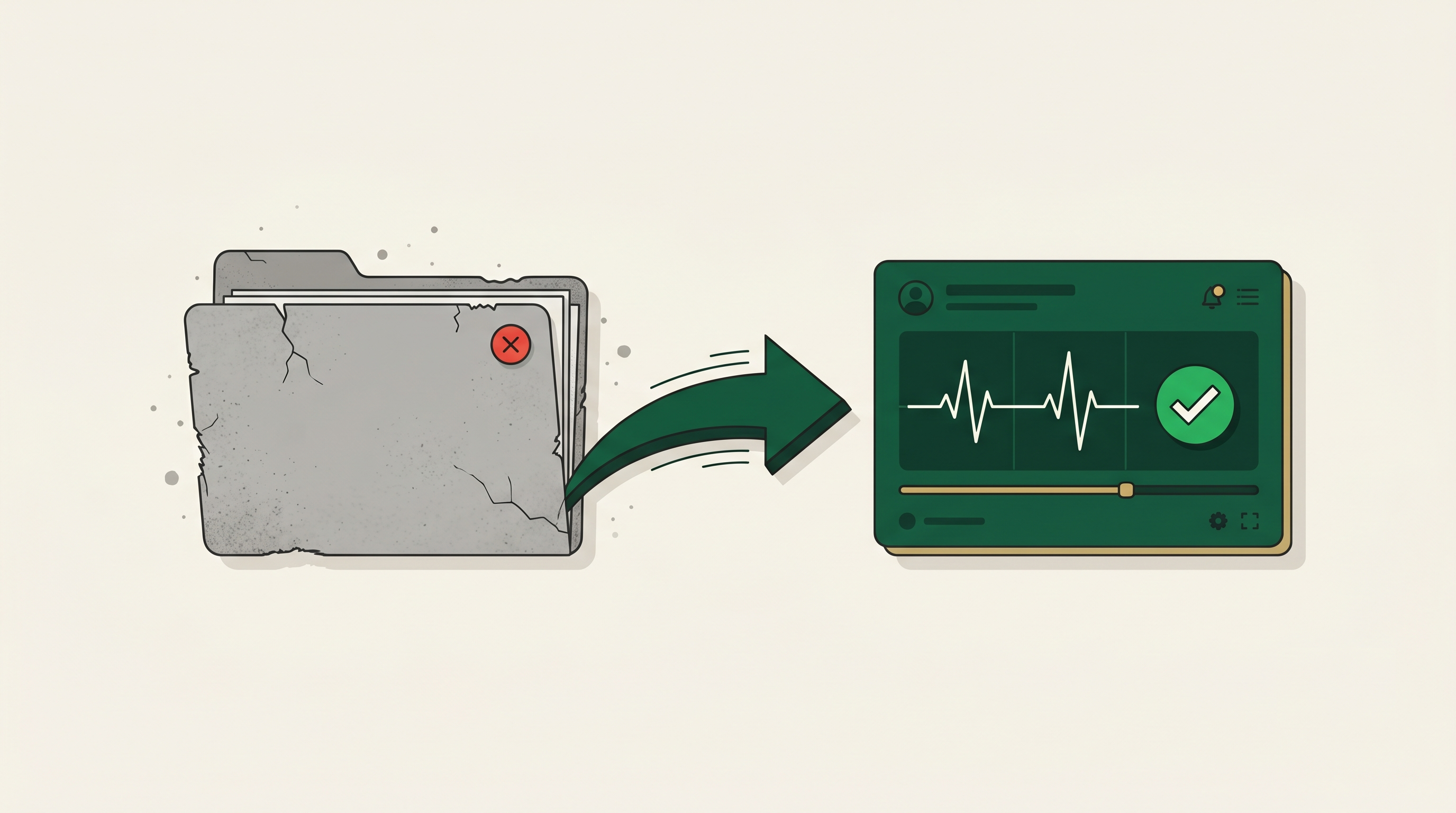
Why Static KYC Folders Fail
Here is why KYC document management for reverse KYC requires a live profile

Geoffrey Safar
July 24, 2026
If you manage Operations or Compliance for an asset manager, you almost certainly have a folder somewhere: a shared drive, a data room, or a neatly organised Dropbox. It contains your certificates of incorporation, UBO documentation, source of funds letters, and constitutional documents. It took real effort to assemble. And it is already out of date.
Not because you are disorganised. Because a folder is a snapshot. The moment you share it with a bank, a prime broker, or a counterparty, that copy begins to diverge from reality. If a director changes, a fund document is re-dated, or a certificate of good standing lapses, every copy you have already shared is now wrong, and you almost certainly do not know who holds those copies.
This is the core flaw in static KYC folder management, and no amount of better filing or tighter naming conventions will fix it.
The folder feels organised. It is already out of date.
The appeal of a KYC folder is understandable. Compliance feels controlled when documents are labelled, sorted, and findable. But the folder model assumes KYC is a one-time delivery: gather everything, send it, and the job is done. In practice, AML/KYC obligations are continuous. Counterparties re-run due diligence on periodic cycles. Banks trigger refresh requests when ownership changes. New investors ask for a full AML document pack before committing capital.
Each time, you return to the folder. You discover some documents are no longer current. You chase updated versions, reassemble, and send another copy into the world. The cycle repeats.
Seven reasons static KYC folders break down
1. They are a snapshot, not a state
A document captured in a folder reflects the entity at the moment the document was created. A certificate of incorporation may be accurate forever; a source of wealth letter or a notarised UBO declaration may not be. The folder treats both identically. There is no mechanism for the folder itself to signal that something inside it has expired.
2. No single source of truth
When you send a KYC folder to three counterparties, three copies exist in three locations under three different custodians. If you update your constitutional documents, you now have a new version on your side and three stale copies elsewhere. Which one is accurate? For each counterparty, the one they hold.
3. Version drift across requesters
As requests accumulate, each recipient holds a slightly different combination of documents cut at a slightly different point in time. Reconciling which counterparty has which version is practically impossible without dedicated tracking.
4. No expiry tracking
Good AML document management requires knowing when a certificate is due for renewal, when a passport copy will lapse, or when a source of funds letter needs refreshing to remain compliant. A folder provides no alerts, no expiry dates, and no mechanism for proactive renewal. The first sign that something has lapsed is usually a rejection or an urgent chase from a counterparty.
5. No audit trail of who holds what
When a regulator asks who has been given access to your AML documentation, a folder cannot answer. You may be able to reconstruct a partial picture from email threads, but there is no governed record of who received which documents, when, and under what terms. That gap is a real compliance risk: the Wolfsberg Group's CBDDQ framework (available at wolfsberg-group.org) places explicit weight on documented, auditable due diligence processes.
6. Over-sharing risk
To be safe, most fund managers send everything in the folder rather than curating by request. This creates a different problem: counterparties receive documents they do not need, including personal data belonging to directors, UBOs, and employees. Over-sharing is both a data protection risk and a professionalism issue. The right answer is access to exactly what is needed, nothing more.
7. They scale badly across multiple funds
For a manager running a single fund, the folder problem is manageable, if inefficient. For a manager with four funds, two SPVs, and a management company, each with their own entity profiles and overlapping ownership layers, the folder model collapses. You end up maintaining parallel folder sets, scrambling to update them in sync, and losing track of which fund sent what to whom. For how this plays out across a multi-fund estate, see our guide on managing KYC across multiple funds.
The reframe: KYC is a living state, not a document
Rather than sending copies of your documentation to each counterparty, the more sustainable model is granting access to a current, maintained profile. When something changes, it changes once, at the source. Every counterparty with access sees the current version automatically.
This is the logic behind a standard AML document pack: not a bundle of files you assemble per request, but a structured, maintained set of records. The live AML passport model takes this further, as explored in the live AML passport model for asset managers.
How Steward replaces the folder
Steward is built around this model. It maintains a live, always-current AML/KYC profile for your entity. You grant access to that profile; you do not copy and send files.
When a counterparty requires your documentation, you grant them access to the relevant parts of your Steward profile. When a document expires or an ownership structure changes, you update it once. The update propagates to every party that holds access. You retain a governed log of who has access to what and when access was granted.
The result is one source of truth per entity, not a proliferating set of folder copies in various states of staleness. Audit-readiness is built in. Over-sharing is designed out. The time spent reassembling documents for each new request drops sharply.
For managers handling multiple funds, Steward's structure maps across your entity estate, so the same discipline that governs your main fund applies to every SPV and parallel vehicle underneath it.
If you are currently managing your AML documentation in a shared drive or data room, the honest question is not "how do I organise it better?" It is "how do I stop creating copies altogether?"
Find out more on the Steward product page or see pricing.
Book a demo to see how Steward replaces your KYC folder with a live, maintained profile.
Related Insights

What should trigger a fresh look at an approved investor?
When approved investors change: triggering fresh KYC reviews without waiting for scheduled updates. Detect ownership shifts, funding changes and screening alerts.

What actually closes an AML remediation finding?
AML remediation findings require proof the underlying control works, not just task completion. Learn what regulators expect from effective remediation.

Source of wealth and source of funds in investor onboarding
Distinguish source of wealth from source of funds in investor onboarding. Learn why identifying money origins matters for effective KYC compliance.